Showing posts with label Stimulus Spending. Show all posts

Wednesday, April 8, 2009

Creating Wealth from Waste - Slideshow

Vermiculture
View more presentations from eusoon.   

This presentation is what I proposed to the Pakatan Rakyat state governments on solid waste management.  The fiscal aspect of the project is outline in Creating Wealth From Waste

The executive summary of the project is outlined in  Alternative Option on Solid Waste Management for Pakatan Rakyat State Governments


Tuesday, March 24, 2009

Stimulus Spending- Green Economy?

The year 2007 witnessed a worldwide food prices hike and drop of supplies. The United Nations Food and Agriculture Organization warned that the changes represent an “unforeseen and unprecedented” shift in the global food system, threatening billions with hunger and decreased access to food. 

Severe food shortages, price spikes threaten world population

By Naomi Spencer
22 December 2007

Worldwide food prices have risen sharply and supplies have dropped this year, according to the latest food outlook of the United Nations Food and Agriculture Organization. The agency warned December 17 that the changes represent an “unforeseen and unprecedented” shift in the global food system, threatening billions with hunger and decreased access to food.

The FAO’s food price index rose by 40 percent this year, on top of the already high 9 percent increase the year before, and the poorest countries spent 25 percent more this year on imported food. The prices for staple crops, including wheat, rice, corn and soybeans, all rose drastically in 2007, pushing up prices for grain-fed meat, eggs and dairy products and spurring inflation throughout the consumer food market.

Driving these increases are a complex range of developments, including rapid urbanization of populations and growing demand for food stuffs in key developing countries such as China and India, speculation in the commodities markets, increased diversion of feedstock crops into the production of biofuels, and extreme weather conditions and other natural disasters associated with climate change.

Because of the long-term and compounding nature of all of these factors, the problems of rising prices and decreasing supplies in the food system are not temporary or one-time occurrences, and cannot be understood as cyclical fluctuations in supply and demand.

The world reserves of cereals are dwindling. In the past year, wheat stores declined 11 percent. The FAO notes that this is the lowest level since the UN began keeping records in 1980, while the US Department of Agriculture (USDA) has reported that world wheat stocks may have fallen to 47-year lows. By FAO figures, the falloff in wheat stores equals about 12 weeks worth of global consumption.

The USDA has cautioned that wheat exporters in the US have already sold more than 90 percent of what the department had expected to be exported during the fiscal year ending June 2008. This has dire consequences for the world’s poor, whose diets consist largely of cereal grains imported from the United States and other major producers.

More than 850 million people around the world suffer from chronic hunger and other associated miseries of extreme poverty. According to the FAO, 37 countries—20 in Africa, 9 in Asia, 6 in Latin America, and 2 in Eastern Europe—currently face exceptional shortfalls in food production and supplies.

Those most affected live in countries dependent on imports. The poorest people, whose diets consist heavily of cereal grains, are most vulnerable. Already the poor spend the majority of their income on staple foods—up to 80 percent in some regions, according to the FAO. Ever-rising prices will lead to a distinct deterioration in the diets of these sections of the population.

The food crisis is intensifying social discontent and raising the likelihood of social upheavals. The FAO notes that political unrest “directly linked to food markets” has developed in Morocco, Uzbekistan, Yemen, Guinea, Mauritania and Senegal. In the past year, cereal prices have triggered riots in several other countries, including Mexico, where tortilla prices were pushed up 60 percent. In Italy, the rising cost of pasta prompted nationwide protests. Unrest in China has also been linked to cooking oil shortages.

In addition to the cost of imports, war and civil strife, multiple years of drought and other disasters, and the impact of HIV/AIDS have crippled countries’ food supply mechanisms.

Iraq and Afghanistan both suffer severe shortfalls because of the US invasion and ongoing occupation. North African countries are hard hit by the soaring wheat prices because many staple foods require imported wheat.

Countries of the former Soviet Union are facing wheat shortages. People there spend upwards of 70 percent of their incomes on food; the price of bread in Kyrgyzstan has risen by 50 percent this year and the government released emergency reserves of wheat in the poorest areas to temporarily ease the crisis.

In Bangladesh, food prices have spiraled up 11 percent every month since July; rice prices have risen by nearly 50 percent in the past year.

Central American countries saw a 50 percent increase in the price of that region’s staple grain, corn. Several countries in South America have also been impacted by the high international wheat prices, compelling national governments to dispense with import taxes. The government in Bolivia, for example, has dispatched the military to operate industrial-scale bread bakeries.

All national governments are keenly aware of the possibility of civil unrest in the event of severe food shortages or famine, and many have taken minimal steps to ease the crisis in the short term, such as reducing import tariffs and erecting export restrictions. On December 20, China did away with food export rebates in an effort to stave off domestic shortfalls. Russia, Kazakhstan, and Argentina have also implemented export controls.

But such policies cannot adequately cope with the crisis in the food system because they do not address the causes, only the immediate symptoms. Behind the inflation are the complex inter-linkages of global markets and the fundamental incompatibility of the capitalist system with the needs of billions of poor and working people.

The volatility of the financial markets, driven by speculation and trading in equity and debt, intersects with the futures and options markets that have a direct bearing on agricultural commodity markets. As the housing market in the United States collapsed, compounding problems in the credit market and threatening recession, speculation shifted to the commodities markets, exacerbating inflation in basic goods and materials. The international food market is particularly prone to volatility because current prices are greatly influenced by speculation over future commodity prices. This speculation can then trigger more volatility, encouraging more speculation.

Future grain prices are a striking example of this disastrous cycle. On December 17, speculation on wheat and rice for delivery in March 2008 forced prices to historic highs on the Chicago Board of Trade. Wheat jumped to more than $10 a bushel on projections of worsening shortages and inflation. This level is double the $5-a-bushel price of wheat at the beginning of 2007.

Japan, the largest wheat importer in Asia, announced December 19 that it may raise wheat prices by 30 percent. The same day, Indian government officials warned of impending food security problems. These were due, according to Prime Minister Manmohan Singh, to “clouds on global financial markets following the sub-prime lending crisis.”

Soybean and corn prices have also been pushed up to 34-year and 11-year highs, respectively, on the projected shortages and demand for biofuel. These new trading levels become the agricultural benchmarks for subsequent trading, and, as the Financial Timesput it December 17, have the consequence of “raising inflationary pressure and constraining the ability of central banks to mitigate economic slowdown.”

Higher fuel costs ultimately lead to higher food prices, via higher shipping charges, particularly for nations that import a large proportion of their staple foods. Shipping costs for bulk commodities have increased by more than 80 percent in the past year and 57 percent since June, according to the Baltic Exchange Dry Index.

The FAO report noted that the enormous increase in freight costs has had the effect of dis-integrating the world market in certain regions because many import-heavy countries have opted to purchase from closer suppliers, resulting in “prices at regional or localized levels falling out of line with world levels.”

The rising oil price not only affects the costs of transportation and importation. It also has a direct impact on the costs of farm operation in the working of agricultural and industrial processing machinery. Moreover, fertilizer, which takes its key component, nitrogen, from natural gas, is also spiking in price because of the impact of rising oil prices on the demand and costs of other fuels. By the same token, as oil prices rise, the demand for biofuel sources such as corn, sugarcane, and soybeans also rises, resulting in more and more feedstock crops being devoted to fuel and additives production.

In the US, the use of corn for ethanol production has doubled since 2003, and is projected by the FAO to increase from 55 million metric tons to 110 million metric tons by 2016. The US government is more ambitious. On December 19, President Bush signed a new energy bill into law which contains a mandate for expanding domestic biofuel production five-fold over the next 15 years, to more than 36 billion gallons a year. Already a third of the US corn harvest is devoted to ethanol production, surpassing the amount of corn bound for the world food markets.

As more US cropland is devoted to ethanol-bound corn, other major agricultural regions are struggling with weather disasters associated with climate change. Australia and the Ukraine, both significant exporters of wheat, have suffered extreme weather that damaged crops. A prolonged drought in southern Australia has curtailed farming to such a degree that many farmers have sold their land.

Current research suggests that as temperatures rise over the next fifty years by 1 to 2 degrees Celsius, poor countries may lose 135 million hectares (334 million acres) of arable land because of lost rainfall. In new studies published earlier this month in theProceedings of the National Academy of Sciences, researchers have cautioned that this estimate may be conservative, and that the impact of climate change on food production has been over-simplified.

According to NASA/Goddard Institute of Space Studies researcher Francesco Tubiello, complications of climate change on the world food supply may be far worse than previously predicted: “The projections show a smooth curve, but a smooth curve has never happened in history. Things happen suddenly, and then you can’t respond to them.”

Tubiello’s research focuses on extreme weather events that have devastated entire crops when they coincided with germination and blossoming periods, as was the case with Italy’s corn crop in 2003. Tubiello noted that corn yield in the Po valley growing region fell to 36 percent following a heat wave that raised Italy’s temperatures 6 degrees over the long-term average.

In addition to the survival thresholds of plants, researchers have begun studying the effects of higher temperatures on the physiology and diseases of livestock, as well as the spread of pests, molds and viruses native to tropical zones. Goddard Institute research has suggested that bluetongue, a viral disease of cattle and sheep, will move outward from the tropics into regions including southern Australia. According to the Earth Institute at Columbia University, higher temperatures will lead to higher infertility in livestock and lower dairy yields.

The implications of these studies are that farming adaptations such as hardier crops and shifts in planting times may initially mitigate anticipated global warming. Yet over the coming decades, the stress of climate change on the food supply will also intensify in abrupt and catastrophic ways for which the capitalist system and its ruling elites are entirely unprepared and which they are unable to prevent.

 In spate of the fact, our leaders continue to turn a blind eye to agriculture sector when come to stimulus spending. Even when foreign direct investments run dry and the nation is reeling into an economic downturn, our leaders still in favor of export orientated manufacturing. 

The New Economic Vision for Penang and Malaysia

 Speech of Penang Chief Minister, The Rt. Hon. Lim Guan Eng At An International Conference on “The New Economic Vision for Penang and Malaysia” December 5 & 6, 2008 (Friday & Saturday)Traders Hotel, Penang 

1. When I took over the helm of the State Government on March 9, 2008, I made a pledge to the people of Penang that we will be fair, just and not discriminate against anyone. The people of Penang had created history by allowing the opposition parties to form the State Government and we have formed a government based on unity and respect for basic human rights and political equity.

2. The new State Government will not disappoint the people of Penang and we want to turn a new chapter. We were determined to do better in drawing in more investments. 

Projects Approved by State, 2008 and 2007 ( Ringgit Malaysia ,RM )

US – USD


2007 : US$1 = RM3.44 2008 : US$1 = RM3.49

3. For the whole of 2007, Penang drew in RM 4.77 billion in investments comprising RM 3.14 billion in foreign investments and RM 1.63 billion in domestic investments. We have exceeded that figure with RM 8 billion for the first nine months of the year comprising RM 4.8 billion in foreign investments and RM 3.2 billion in domestic investments (MIDA figures). Penang placed third this year as compared to 5 th last year. Were it not for the global financial crisis. I am confident that we would have hit the RM 10 billion mark.

4. As it is Penang has already broken all records in attracting the highest number of foreign investments in history. And these investments are high quality investments focusing on the main high-tech sectors in electrical and electronics industry such as LED and wafer fabrication as well as biotechnology in genetic testing for cancer detection with branded companies such as Honeywell, National Instruments and Ibiden. On top of that we have existing foreign MNCs reinvesting billions of ringgit for expansion purposes.

5. We believe that the quality investments in Penang, whether new or existing ones In this regard we want to pull in investors that are capital intensive, offer high-paying jobs, high-technology focused, centered on knowledge workers in sunrise industries. To help us determine the type of investors we want, there are eight characteristics of highly successful companies we look out for that I describe as the 8S- Standards (in the forefront of creativity innovation and research), Segmentation(diverse products in the marketplace), Scalability, Service, Schedule Adherence, Security of products, Sustainability and Corporate Social Responsibility.

6. We realize that we Penang is a land and resource scarce state, we must focus on our human resources, our strong work ethic and human talents to grow and prosper. We are therefore pleased that software solution companies have made Penang their prime target such as the No. 1 business solution provider SAP through their local franchise holder AXON has decided to to invest RM 100 million to create.250 high paying professional IT engineers in Penang.

7. We will continue such efforts which must be now redesigned and refocused to deal with the oncoming recession brought about by the global financial crisis. The Penang state government is adopting an expansionary budget for 2009 with a higher budget deficit of RM 39.4 million or 8.3% of the total budget as compared with 8.1% for 2008. The three key thrusts are pro-growth, pro-jobs and pro-poor.

8. With increased social programmes and public works, we will try to mitigate the effects of the economic slowdown. For a start, we aim to eradicate poverty in the State of Penang by March 2009, that is, a year after we have taken over the State Government. To achieve this aim, I would like to urge the private companies to join us as “Partners Against Poverty” through your companies’ corporate social responsibility (CSR) programmes.

9. However, presently, we have more urgent matters at hand. The global financial system is in shambles and recessions in the United States and Western Europe now seem unavoidable. People will lose their jobs and it is anticipated that additional jobs will not be created even after a few quarters subsequent to the economic recovery.

10. This is indeed a challenging time for economic management in Penang, Malaysia as well as the rest of the world. As we have to identify appropriate short-term measures to offset the coming economic downturn, we should also treat this downturn as a wakeup call for us to reconsider our development strategies to ensure that the forthcoming strategies respond to the desired growth path for Penang.

11. The future economic vision for Penang rests on continuing to develop our human resources, especially the cutting edge high-tech and computer segment. In other words, knowledge workers will be our key contributors of economic growth. This is in line with services sector contributing 57% of Penang GDP followed by 39.5% from the manufacturing sector.

12. If we can transform Penang’s economy from being a being a sweat-shop of the world to a smart shop, we have succeeded in moving up the value chain. We need to concentrate on the best knowledge-workers in Penang where we have the best engineers, doctors, nurses, accountants, pharmacists, lawyers, town planners, surveyors and architects. That is why Penang launched our free wireless initiative where we hope that in 2 years time, when you open your notebook or computer you can be connected to the internet, any time, any place, anywhere but only in Penang.

13. Making Penang a smart shop will go a long way towards transforming Penang an international city that is a location of choice for investors, a destination of choice for tourists and a habitat of choice for those who desire sustainable living.

14. For Malaysia to face the challenges of economic recession, we need an expansionary budget that is significant enough to make a difference. China’s foreign/international reserves are almost USD 2 trillion and yet they are willing to spend USD4trillion or double their international reserves to revive their economy and perhaps the world economy. In comparison, Malaysia’s foreign reserve is USD100 Billion and we are suggesting a USD2 Billion (Rm7Billion) economic stabilization plan which is only 2% of our foreign reserves. Why spend only 2% when China can spend double. Malaysia should spend RM50billion (USD14billion) of fiscal and monetary measures comprising

(1). Financial aid to distressed families of RM6,000 annually for those earning less that RM6,000/month amounting to RM35billion
(2). Monetary measures of cutting the corporate tax rate from 25% to 17% costing RM13billion
(3). RM2billion spending to provide wireless services and facilities to all key towns and cities.

15. We need a strong expansionary budget and economic stimulus program to counter the economic slowdown and also improve our infrastructure and education fundamentals so that we can take advantage of any economic recovery. A bigger expansionary budget is necessary with the latest Bank Negara figures showing a negative portfolio investment outflow of RM41.3 billion for the first 9 months of the year.

16. An expansionary budget must be implemented in a manner that is significant and speedy or else it will help no one.

17. In close, we must look beyond the recession by boldly spending on job retraining, increase the number of knowledge workers, upgrade our ICT infrastructure and strengthen our education structure as a center of excellence. Make Penang the smart shop of Malaysia and the region – that’s our future.


The Penang Economy 

The economic growth of Penang has been driven by  the manufacturing and the  service sectors, which accounted for about 95 per cent of the state GDP in the 1990  - 2000 period (Table 1).  The remaining 5 per cent was shared between the other three major sectors comprise, mining and construction.  The economic structure has somewhat stabilized although the manufacturing sector seemed the registering some gains in 2000.  This structural composition of the economy differs substantially from the national economy,  where the manufacturing and the service sectors contributed to about 85 per cent of the GDP and the other 3 major sectors still accounted for 15 per cent of the GDP.  As such Penang is much ahead in its industrialization as compared the rest of the country.  This also means that the role played by the agr icultural sector in the state economy is very much less as compared to the rest of the nation.  This may make the task of revitalizing the sector more difficult as resource structure and allocation has favored the others sectors much more than the agricultural sector.  


The Agricultural Sector in Penang 

 The agricultural sector in Penang currently contributed to just 1.3 per cent to the total GDP.  During the last decade the sector’s share has shrunk by more than 55 per cent, from 2.9 per cent in 1990.  The contribution of the sector had not only decreased in percentage terms but also in absolute terms, from RM228.4 million in 1990 to RM227.7 million in 2000. 

It is the only sector that recorded negative growth in the state (Table2).  It is obvious productivity gains in this sector were not able to match the productivity gains in the other sectors resulting in the outflow of resources from agriculture to the other sectors.  


(Source: The Agriculture Sector in Penang:  Trends and Future Prospects by Tengku Mohd Ariff Tengku Ahmad2)

 To build sustainable and self-reliant communities, the agriculture sector should assume a versatile and important role in regards to the social and economic development as well as the stable living of the general public, including the maintenance of vitality in regional society and the conservation of the national land and natural environment.

 As we come face to face with an imminent economic recession, we have to come to grips with the possibility of mass unemployment and hyper-inflation. We just can not afford to depend on imported food which bound to burden the people with escalated price. We should also exploit the potential of the agriculture sector for future employment opportunities. It is high time for the state government to review the present agriculture policies.

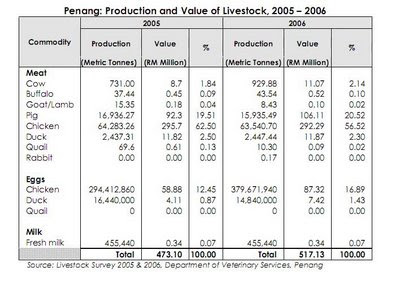
 The agriculture lands have been declined from 51,344 hectares (2001) to 49,339 hectares in 2006. This showed there is a fierce competition for land from other sectors of the economy. Only about 13697 hectares of land is use for vegetables and paddy cultivation. Where as about 6812 hectares of land is use for the production of local fruits. The rest of the agriculture lands are use for agribusiness that guarantee maximum short term financial return.




(Source:  Penang Statistics)


A fundamentally new approach towards sustainable agriculture should be adopted to rectify the inadequacy of present agriculture policy. The state government should adopt the following action plan which seeks to promote:- 

1.      Environmentally conscious agriculture

Applying a maximum level of environmentally friendly qualities of agriculture as material circulating industry, in addition to further enhancing the environmental conservation functions of agriculture, the government should comprehensively promote the following activities, and establish environmentally conscious agriculture, from the perspective of reducing environmental load as much as possible.

·        The state government should properly assess the functions of agriculture and rural communities in the conservation of the state land and the environment, and should maintain and increase these functions,

·        The state government should develop and spread technology for environmentally conscious agriculture, which is not greatly dependent on chemical fertilizers and agricultural chemicals, and through which the conservation of the environment and sustainable agricultural reproduction is possible,

·        Recycled use of agricultural wastes, including the manure of livestock and paddy husk. 

2.      Brake on downward trend in food self-sufficiency

The state government should seek to maintain and increase the domestic agricultural production as much as possible, by means of improving the quality and cost of domestic production, such as accelerating the increasing productivity in the domestic agriculture, and to put the brake on downward trend in food self-sufficiency rate. 

3.      The improvement of agriculture and rural areas

The state government should promote comprehensive improvements in rural regions, including improvement of production infrastructure, which includes that for larger farmland, farm roads, and main facilities for irrigation and drainage for the purpose of realizing attractive agriculture, and improvement of facilities for rural sewerage for the purpose of forming pleasant and beautiful pastoral spaces, as well as improvements for maintaining and creating safety in regards to the national land. 

4.      The activation of agriculture and rural areas

The state government should promote activities to contribute to the activation of agriculture and agricultural districts in mainly hilly areas which are put under unfavorable natural and economic conditions, and are confronted with hard conditions from the standpoint of maintaining a sound regional society, due to decreasing population, mainly among the young, the aging population, and stagnation in activities for agricultural production.

For this reason, in addition to promoting agriculture which puts to use special regional characteristics, improving the structure of agriculture, and making improvements in the living environment in fields for which there have been delays in rural areas, when compared to urban areas, the state government should engage itself in promoting the culture and history of rural regions, the practical application of resources and technologies which are peculiar to individual rural regions, the acceleration of exchange between rural and urban areas, and creating scenic rural spaces. 

5.      The development of  energetic agricultural production

In order to achieve advanced agricultural production, in addition to promoting the fostering of management bodies to conduct efficient and steady management, as well as excellent human resources, including youth among the farming sector, to support these management bodies, the state government should promote the realization of high-productivity and high-quality agriculture through the creativity of the various local areas, as well as measures for the furtherance of stockbreeding, and the production of fruit and vegetables.

In addition to promoting the prevention of epidemics among vegetation, with due consideration given to soil conservation and the environment, the state government should also develop new varieties of crops and adopt superior seeds and seedlings, using biotechnology.

6.      The provision of a steady supply of food, and the promotion of food industry

As regards such food as rice, meat and vegetables, which are essential to the general public in everyday life, in addition to securing stabile prices, supply and demand. The state government should also promote comprehensive environmental measures throughout the stages of the production, distribution and consumption of food. 

7.      The development  and the spreading of technology

The state government should promote the development of technology for improving agricultural productivity, fostering new varieties of crops, the creation and use of a gene bank for collecting and storing genetic resources which make up the basis for the development of a variety of crops, and technological development for the furtherance of the use of the biomass. In particular, the state government should promote the development of technologies on sustainable agriculture, such as integrated pest management technology incorporating the biological pest control whose environmental effect is sufficiently considered as well as the introduction of resistant varieties of crops to pests, etc., and management technology for the appropriate fertilization and cultivation for the purpose of conserving land fertility and the soil of farmland. The state government should also seek to develop maintenance and management technology for farmland in order to make agriculture demonstrate its functions of environmental conservation.

Also, in order to achieve the diffusion and permeation of technology among the farming sector, the state government should promote dissemination activities through facilities for the spread of agriculture improvement. 

8.      Wholesale and Distribution Center

Wholesale market and distribution center should be established to facilitate the sustainable management, development and expansion of agriculture sector. This will help eliminate market exploitation by middlemen through facilitating or exploring marketing channels for the produce of the farmers.

 In addition to promoting efficiency in the use of energy in the farming sector, the state government should promote the practical application of natural energy in regions, conduct research to stop soil pollution on farmland, and devise measures to deal with polluted soil.

 The South-West district should be promoted as the Green Belt of the island to produce more of our own food, and to provide a healthy diet, timber and fibres, and ultimately all renewable resources, by means which are sustainable, non-exploitative and ecologically benign.

 NGO like Organic Farm should be encouraged to play an active part to promote organic agriculture which seeks to work with ecological processes. Organic farming methods should be integrated with the culture of ecologically suitable trees with a multiplicity of uses  and policy measures to achieve other objectives, such as the stability and prosperity of rural areas, conservation of wildlife habitats , equity of income distribution , recreational, landscape, water and energy policies. 

This write-up was originally written for Penang DAP in 1999 as an attempt to rejuvenate its image. Since Penang DAP finally  come to power, it is time for Penang DAP to  swallow its own medicine, which was originally  prescribed to the standout incompetent among the failures, Koh Tsu Koon. 

Stimulus Spending – Hope and Betrayal

By echoing the urge to keep spending wantonly, our politicians act like they are economic experts when talk about stimulus spending, If the recession is  U shaped, stimulus spending might be the answer to ensure a soft landing. As days passed by, more and more economists have become pessimistic over the recession; some even argued that it could end up being L-shaped. If the highly respected senior Minister Mentor of Singapore, Lee Kuan Yew, is right about the economy recovery, then the stimulus spending will not going to make a difference.

Singapore may take up to six years to recover: Lee Kuan Yew

SINGAPORE, March 21 (Reuters) - Singapore's export-dependent economy will take at least three years to recover from the recession triggered by the financial crisis, the Southeast Asian country's most powerful politician was quoted as saying.
The daily Straits Times on Saturday quoted former Prime Minister Lee Kuan Yew as saying that a recovery within two to three years was part of an optimistic scenario that assumed a turnaround in the U.S. economy next year. Under a pessimistic scenario, it could take up to six years for the island-state to bounce back from recession, he said.
He has previously said that Singapore's recovery depends on that of the United States and that the world's biggest economy was "fundamentally sound".
Lee, 85, was modern Singapore's first prime minister and held that office for 31 years. He remains a powerful player in the small country's politics and serves as "minister mentor" in the cabinet of his son, Prime Minister Lee Hsien Loong.
Earlier this month, Lee forecast that gross domestic product of the island of 4.8 million people could shrink by 10 percent this year.
He also said he was reassured by U.S. Federal Reserve chairman Ben Bernanke's remarks in February that the economy of the United States would pick up by 2010, once the government's stimulus package frees up lending to households and businesses. The newspaper separately reported that up to 66,000 Singapore civil servants could face a cut in their salaries this year as a result of the economic slowdown. (Reporting Harry Suhartono; Editing by Jan Dahinten)


Our leaders failed us once, and fail us again and again. It is painful for us to see our leaders roll out all sorts of wishful thinking rather than a proper plan on economy recovery. Penangites in particular and Malaysians in general were shocked by the willful naiveté of Lim Guan Eng to have a tiger park with a controversial twist on eco-tourism. Lim Guan Eng fails to look into job creation, sustainability and the need to have an austerity drive to help us weather through economic hardship. Instead he comes out with a project that would be too expensive to maintain and could lead to illegal wildlife trade. Lim Guan Eng’s big mouth and his penchant for cheap publicity have already eroded his credibility considerably.

The quality of life in Penang has seriously deteriorated over the last few decades under the rule of BN. There has been widespread consensus heretofore that there is a need to replace the BN government. As a result, Lim Guan Eng and his team were elected with landslide victory, totally eliminated the Gerakan and MCA from Penang’s political landscape. As we still indulge in the joy of upsetting the BN state-government, Penangites slowly realized that Lim Guan Eng is ill-prepared in running the state-government.

We expect our leaders to come out with a clear strategic vision to lead the state, and translate the vision to a reality, not wishful thinking without any focus on issues at hand. The new state-government claims to champion competency, accountability and transparency, yet accountability and transparency were apparently not in its lexicon; the state-government opts for a non participatory approach, defeating public consultation and participation to its own detriment.

Without the help from the people, the Penang state government is struggling to come to term with the issues faced by Penangites, and tend to develop solutions that deal with crises in isolation from one another, thereby limiting understanding of the mutually reinforcing and cumulative impact. This conceptual failing contributes to Lim Guan Eng’s heavy reliant on developers and the federal government for development; a trait of political incompetence and lack of political imagination.

For instance, despite protest from concerned Penangites and general consensus that any project on hill slope over 35º gradient should be banned, the Penang state-government still remain indecisive over the project at Solok Tan Jit Seng, where the gradient of the slope is over 60º, without taking account into consideration the safety aspect, the environmental impact and the political repercussion. What concerned the state-government is the deprival of so called development, which only benefits a few but at the detriment of the majority of Penangites.

At a time when the economy downturn has led to lost of job and slower hiring, green economy is booming else where except the Bolehland.

Need a Job? Look to Green Economy
By Tucker, Libby
Publication: Daily Journal of Commerce
Date: Wednesday, June 4 2008

At a time when Oregon's economic downturn has led to slower hiring, the clean energy industry is madly recruiting graduating students and professionals looking to change careers. And workers are flocking to the state's emerging green sector.
More than 300 job seekers and employers in the energy efficiency and renewable energy industries packed The Governor Hotel in downtown Portland for the Green Professional's Conference held Monday.
"I'm looking everywhere for work, but energy will be the major industry in the future," said Mathew Ladd, a Portland State University student who attended the conference with an eye out for sales or marketing jobs.
The event - part pep rally for sustainable industries, part job fair - marked Portland's first energy conference focused on networking and job development for a sector that's become the linchpin of Oregon's economic development strategy.
"It's a good time to get into this field," Colin Sears, sustainable industries manager for the Portland Development Commission, told a roomful of students and prospective workers. "In Oregon, it's critical to develop this sector. ... We don't want to import labor."
The emerging renewable-energy and energy-efficiency industries already account for 8.5 million jobs in the U.S., and the sectors will create as many as 40 million new jobs by 2030 in engineering, manufacturing, construction, accounting and management, according to a green-collar job report released in January by the American Solar Energy Society.
Oregon's green economy is also set to explode over the next few years, creating thousands of jobs in the clean energy industry. In the last year alone, three major solar manufacturers have moved to Oregon. They're accompanied by a host of related businesses turning toward the emerging sector, including investment firms, non-profits, marketing consultants, architects and builders.
"Oregon has set a goal to lead the nation in sustainability and we're looking for ways to translate that reputation into a competitive advantage," said John Morris, a director for Fluid Market Strategies, one of four firms that organized the conference. "There's a growing demand for a skilled workforce to deliver conservation, efficiency and renewable power. The energy industry is at a crossroads in its growth."
But the state has much work to do training and recruiting workers for the emerging industry, said Tom Osdoba, an economic development manager for the Portland Office of Sustainable Development.
"We need to much more aggressively move forward on a green objective. The days of incremental change are coming to an end," said Osdoba. "Portland is a leader in so many ways, but we still have a long way to go."
The Green Professional's Conference was a step in the right direction. College students from across the state, as well as workers in all different levels of their professions attending the event, mingled with recruiters from the region's utilities, nonprofits and private firms and attended presentations on the future of the energy industry.
The Bonneville Power Administration, Energy Trust of Oregon, Northwest Energy Efficiency Alliance, Earth Advantage, The Climate Trust and a handful of other employers presented their own programs and employment opportunities.

One may like to ask, can we create our own green economy that take into consideration sustainability? In my previous 2 write-ups, I have outlined 2 green economies that capable of create thousands of jobs. The first is about sustainable solid waste management and the other is about sustainable public bus transit. The only Penangite get excited about the ideas is Anil Netto, not Lim Guan Eng, as he is more excited with his Tiger Park. (Oop! - Forget LGE is not a Penangite)

The other green economy the state-government should seriously look into is clean water conservation. Since the privatization of our water resources, Malaysians have started drinking from our rivers, which are notorious for its pollution; a silent betrayal that puts our lives and health at stake.

Is it too much to ask Lim Guan Eng, who was once the beacon of hope for disgruntled Malaysians, to look into clean water conservation, our most precious resource?

The emerging of Low Impact Development (LID) ushers in a new era of stewardship and collective responsibility for global vitality and health. Traditionally the environmentalists and developers are always at loggerhead quarrelling or arguing with each other over the impact of economic activities on environmental preservation. As the economic and environmental benefits of Low Impact Development approaches become clear, more and more design and construction firms, developers and businesses in western countries, suddenly found that it is not really hard to work with environmentalists in their effort to build a more livable community.

It is a recognized fact that polluted runoff rivals (or exceeds!) sewage plants and factories as a source of water contamination.

The Problem of Urban Stormwater Pollution
Our drinking water supplies, shellfishing waters and bathing beaches are fouled by uncontrolled pollution when rainwater and snowmelt wash over city streets, parking lots, and suburban lawns and pick up toxic chemicals, disease-causing organisms, and dirt and trash. This problem is called urban stormwater pollution. Recent studies have found that urban stormwater rivals and in some cases exceeds sewage plants and large factories as a source of damaging pollutants.

Two hundred years of unregulated, unmanaged urban stormwater have contributed to many severe public health problems and expensive natural resource losses in the United States. Left unregulated and uncontrolled, urban stormwater:
• pollutes drinking water sources, filling in reservoirs with clogging silt and oxygen-robbing nutrients and contributing to drinking water emergencies;
• fills in navigable waterways with contaminated sediment, leaving us with increased dredging and spoil disposal costs;
• closes or shrinks lucrative rockfish, shad, flounder, crab, oyster, and other commercial fisheries due to chemical contamination, oxygen starvation, and the resulting loss of habitat;
• fouls beaches and other recreational waters, causing losses in revenues from declines in boating, fishing, duck hunting and coastal tourism;
• scours smaller stream channels and dumps huge gravel and silt loads, ruining fish and amphibian habitat;
• obliterates small streams, springs and wetlands during development (these natural waterbodies are sources of clean ground and surface water and serve as habitat for aquatic life); and
• damages homes and businesses during the flash floods common where stormwater is left uncontrolled
Each of these problems carries heavy costs: increased spending on health care, higher insurance and drinking water rates, declining stocks of commercial fish, and loss of coastal tourism revenues. Americans are spending millions on these symptoms of stormwater pollution instead of trying to control the root cause. (Source: http://www.nrdc.org/water/pollution/fstorm.asp)

Thoughtful community land use planning and development are critical to protecting our community’s water resources. Through LID storm water best practices, our rivers, streams, wetlands, floodplains, and aquifer can be managed to provide safe and plentiful drinking water and livable habitat for wildlife. LID practices are innovative practices that manage stormwater close to its source by mimicing a site's predevelopment hydrology and use design techniques that infiltrate, evapotranspirate, and reuse runoff.

Studies across the U.S. are showing that the short-term construction costs for the LID storm water best practices are actually less than for conventional storm water design. As more engineers, architects, landscape architects and contractors learn how to design and deliver LID storm water management for water resource protection, the cost continue to drop.


This video provides an introduction to the Decatur Street Stormwater Low Impact Development Demonstration Project. This project is a trial of a roadway design which features storage and infiltration of runoff under the pavement section. The project utilitzed three different types of runoff water quality treatment and then routes the runoff into a drainage layer under the pavement for storage and infiltration. The project was jointly funded by the City of Olympia and Washington State Department of Ecology


Neil Weinstein, Director of the the Low Impact Development Center talks to attendees at the Technology Transfer Session about Low Impact Development

Managing storm water is the key to clean water conservation. Flash flood problems not only cause damage to our properties, it also causes pollution to our drinking water sources. When come to flash flood mitigation, Lim Guan Eng still remain indecisive whether to seize the opportunity to promote LID and proper stormwater management.

How do the state government continue to get things done when it don't know what things need doing, when it is unclear about the next step to take?
It can be difficult to move forward without clarity, for clarity of purpose often brings with it enthusiasm and energy. But when clarity is lacking, what is the best response? If clarity is still elusive after giving the issue some thoughtful consideration and doing some good homework, what are our options? Afraid to make the wrong choice, Lim Guan Eng choose to wait and hope for a decision to become obvious, but did he do his homework? That is probably the state of mind of Lim Guan Eng in his day to day running of the state government.

So in the meantime, he still allows river dredging as the ultimate solution for flash flood mitigation. What is the experts’ view on river dredging?

What is dredging?
Dredging is the process of removing silt from the bottom and sides of a river channel.
River dredging is normally done when there is a need to increase the depth of the river and straighten channels. Dredging can also help to improve land drainage by creating artificial channels, and is sometimes done in order to get sand and gravel for construction sites. We carry out lots of work in and around rivers to reduce flood risk and make sure that they are flowing freely. From maintenance of weirs, culverts and sluices, removing rubbish and leaves, and clearing blockages such as shrubs, weeds and even trees, we do everything we can to reduce the risk of flooding. But this doesn’t include dredging.


Why doesn't dredging stop rivers from flooding?
Dredging river channels doesn't make them big enough to contain the huge volumes of water during a flood. When a major flood occurs, water soon fills the river and enters what we call the 'floodplain'. The floodplain is an area of land over which water naturally flows during flooding. Even major dredging will not free up enough space in the river channel to stop this from happening.
Floodplains form naturally as a response to extreme flooding. The idea of dredging to try and tackle extreme flooding is similar to the thought of trying to squeeze all of the water held in a floodplain back into the river. Since the floodplain volume is usually many times bigger than the river channel volume, this would be a major engineering project, and would cause massive environmental change.


Why else don't we dredge?
Dredging is very expensive, and presents a massive cost to the taxpayer with very little return. To make matters worse, dredging would need to be repeated after every major flood. The impact on the environment is another reason that we don't recommend dredging. Removing trees and shrubs from the river bank can actually make the bank less stable, as well as disturbing the natural habitat of river dwellers like otters and voles. Removing gravel also means removing spawning grounds for fish. Dredging around bridges, weirs, culverts and river walls, can also damage their foundations, greatly increasing the risk of flooding. The land levels of floodplains cannot be raised, as they are part of the river's natural storage area. Any silt removed would need to be sent to a tip for disposal, costing more money.

Summary
Silt is deposited on the river bed naturally. During major floods, the river cannot be contained within the normal river channel. Dredging can be effective for improving land drainage, but very rarely helps to stop flooding.
(Source: www.environment-agency.gov.uk)

River dredging not only is an ineffective flood mitigation solution, it also a dangerous source of pollution to our waterways.  Economic stimulus and public works projects must get the nation to work building healthy, livable communities for all. It is not about spending public money wantonly without clear cut objective. 


Tuesday, March 10, 2009

Creating Wealth From Waste

Economy stimulus is not just about aggressive money spending to keep the economy moving. One of the important aspects of economy stimulus is fiscal prudence, which is easily and conveniently ignored in the overzealous move to fasten economy recovery. Least you forget the current financial crisis is due to economy mismanagement. The need to return to fiscal prudence is more urgent than ever, yet our leaders chose to resort to pump pimping without given due consideration to the need of fiscal prudence when talk about economy stimulus.

We need to create wealth from waste, not waste from wealth. This is the reason why I look into vermi-culture as the first initiative for stimulus spending. Vermi-culture provides a possible way to create wealth from waste.

Even without the impending recession, the landfills in Penang are running out of space. The need to look for
alternative solid waste management is getting more and more urgent as day passed by. More over the pollution caused by the leakage of leachate from the Pulau Burung Sanitary Landfill is getting worse.

Penang state government under the leadership of Lim Guan Eng is not different from that of Koh Tsu Koon when come to dealing with solid waste management; it still prefers to look for new landfill sites as a convenient method of getting rid of unwanted waste materials.

According to the previous state government of Gerakan, the average Penangnite throws away about 1.1 – 1.3 kg of waste per person per day and the increment is a cause for concern.

A new policy approach should be adopted to instil a sense of common responsibility towards waste, and to create overall strategies for waste management that do more than pay mere lip service to the concept of sustainability.

Therefore it is imperative for us to look into vermi-culture, to see how much revenues we can generate from it and how it can solve our solid waste problem.

One of the places to learn about vermi-culture is no other than Australia, where compost facilities as shown below are the primary means of getting rid of bio degradable solid waste.


This compost facility is a Vermicrobe system consisting of elevated and covered pits with liquid tanks


The Vermicrobe twin tank recirculation system for creating liquid cast is part of the final system

The detail of the compost facility is as follows:


A 16 modular Vermicrobe International modular earthworm pits stocked with a minimum of 250,000 earthworms (plus cocoons)


B Each modular pit is fitted with pit stands, moisture sprays, two liquid tanks, two sump tanks, three pumps, liquid collectors, control valves, filters and Vermitent frame system


C One pH / moisture meter


D One thermometer


E One Conductivity meter to measure liquid cast concentrate


F One 200 L Compost tea brewer, microscope, one dissolved oxygen meter


G One VI2000 Worm Separator/Harvester


Table 1: Compose Facility


Let look into the initial cost of investment in this facility and the return of investment.

Initial Investment Cost


Capital Investment

Vital Earth Modular Pits

16

Earthworms Kgs Per Pit

75

Cost Per Earthworm Pits

$3,250

Earthworm Modular Pits -Complete Package consist of 6 pits

$66,999

Additional 10 Pits

$32,500

Total Equipment Cost

$99,499

Table 2: Capital Investment


Capital Requirements


Earthworm Modular Pits -Complete Package with 16 pits

$99,499


$99,499

Mobile Office, Store & Fencing

$25,000

Box Trailer

$600


Phone/Fax

$700

Pager

$200


Mobile
Phone

$200


Computer/Printer

$2,000


$28,700

Table 3: Capital Requirement


Finance Requirements


Capital Equipment & Training


$128,199

Working Capital


$41,801

Initial Investment


$170,000

Table 4: Finance Requirement

The initial cost of investment for this facility is US$170,000 or RM 680,000

Worm Breeding Program

Worms are prolific breeders - and double in number every two months. Let see how fast the worms will grow.


Worm Reproduction Rate


Days

120

to double worm weight

Reproduction Rate

1.1920727

per month

Table 5: Worm Reproduction Rate


Month

Opening Stock

Purchase

Natural Increase

Sales

Closing Stock

Jun


1200

230

1430

Jul

1430


275

1750

Aug

1750


328

2033

Sept

2033


390


2423

Oct

2423


465


2889

Nov

2889

555


3443

Dec

3443

661

4105

Jan

4105


788

4893

Feb

4893


940

5833

March

5833


1120


6954

April

6954


1336


8289

May

8289


1592


9881

Table 6: Worms on Hand (kg) for Year 1


Month

Pit Required

Vermicast (kg)

Liquid Cast

(liter)

Jun

19

3433

9411

Jul

23

4092

11255

Aug

27

4879

13416

Sept

32

5816

15993

Oct

39

6933

19065

Nov

46

8264

22727

Dec

55

9852

27092

Jan

65

11744

32296

Feb

78

14000

38499

March

93

16688

45893

April

111

19894

54709

May

132

23715

65217

Table 7: The Projected Pit required and By Products of Vermi-culture in Year 1

With the reproduction rate shown on Table 5, if the initial worms stock is 1200kg, by year end it can grow to 9881 kg. That means by year end you will have sufficient stock to open additional 7 compost facilities. The
total vermicast produced will be 129310 kg with market value of US$64,655. The total liquid cast produced will be 355603 liters with market value of US$889,008. That means total revenue of US$953,663 can be expected within the first years of production, which means by first year the state government can almost recoup the cost of investment.

Let see what happened after Year 2.


Month

Opening Stock

Purchase

Natural Increase

Sales

Closing Stock

Jun

9881


1898

77

11702

Jul

11702


2248

82

13868

Aug

13868


2664

88

16443

Sept

16443


3158

94

19508

Oct

19508


3747

100

23155

Nov

23155


4447

105

23254

Dec

23254


5281

111

27497

Jan

27497


6275

117

32668

Feb

32668


7457

122

46161

March

46161


8866

128

54899

April

54899


10545

134

65310

May

65310


12544

139

77715

Table 8: Worms on Hand (kg) for Year 2


Month

Pit Required

Vermicast (kg)

Liquid Cast

(liter)

Jun

156

28085

77236

Jul

185

33282

91526

Aug

219

39463

108524

Sept

260

46818

128749

Oct

309

55571

152822

Nov

367

65993

181481

Dec

436

78402

215606

Jan

518

93181

256249

Feb

615

110785

304661

March

732

131757

362334

April

871

156744

431046

May

1036

186516

512920

Table 9: The Projected Pit required and By Products of Vermi-culture in Year 2

By end of year 2, the worm stock will grow to 77715 kg. That means you will have sufficient stock for total 64 compost facilities without the need to put in extra money.

The total vermicast produced will be 1,026,603 kg with market value of US$513,301. The total liquid cast produced will be 2,823,160 liters with market value of US$7,057,900. With the sales of 1297kg of worms at retail price of $30 per kg, this will bring in revenue of $38,895. That means total revenue of US$7,610,097 can be expected within the second years of production.

Let see what happened after Year 3.

Month

Opening Stock

Purchase

Natural Increase

Sales

Closing Stock

Jun

77,715


14,927

5,000

87,642

Jul

87,642


16,834

5,000

99,476

Aug

99,476


19,107

10,000

108,582

Sept

108,582


20,856

10,000

119,438

Oct

119,438


20,856

12,000

130,379

Nov

130,379


25,042

15,000

140,421

Dec

170,470


26,971

16,000

151,392

Jan

151,392


29,078

10,000

170,470

Feb

170,470


36,727

12,000

191,213

March

191,213


36,727

16,000

232,648

April

232,648


40,708

20,000

211,940

May

211,940


44,685

14,000

263,333


Table 10: Worms on Hand (kg) for Year 3

Month

Pit Required

Vermicast (kg)

Liquid Cast

(liter)

Jun

1169

210,341

578,437

Jul

1326

238,741

656,540

Aug

1,448

260,597

716,643

Sept

1,593

286,651

788,291

Oct

1,738

312,909

860,500

Nov

1,872

337,010

926,779

Dec

2,019

363,341

999,188

Jan

2,273

409,129

1,125,104

Feb

2,550

458,911

1,262,006

March

2,826

508,656

1,398,803

April

3,102

558,354

1,535,457

May

3,511

631,999

1,737,998


Table 11: The Projected Pit required and By Products of Vermi-culture in Year 3

By end of year 3, the worm stock will grow to 263,333 kg. That means you will have sufficient stock for total 219 compost facilities without the need to put in extra money. With this capacity, the compost facilities will be enough to handle the bio-degradable waste in the whole Penang state without the need to look for new landfill. 

Take a look at the cash flow report and balance sheet, you will realise that this is an investment with very high return.


Cash flow Report


Year Ended


May-10

May-11

May-12

Cash Receipts


Sales – Worms

0.00

19,500.00

6.380,000.00

Sales - Worm Buyback

12,800.00

12,800.00

12,800.00

Sales – Other

707,967.79

5,791,402.81

30,467,302.57

GST Collected

0.00

0.00

0.00

Capital Introduced

170,000.00

0.0

0.00

Bank Loan

0.00

0.00

0.00

Total Receipts

890,767.79

5,823,702.81

36,860,102.57


Cash Expenses


Accountancy

1,500.00

2,000.00

2,000.00

Advertising

84,956.13

694,968.34

4,421,676.31

Bank Charges

14,415.36

116,474.06

737,202.05

Capital Purchases

377,000.00

2,938,000.00

8,043,750.00

Feed

8,081.89

53,987.6

307,790.17

Freight

35,398.39

975.00

1,842,365.13

General Expenses

4,800.00

14,400.00

86,400.00

Insurance

800.00

1,000.00

5,000

Loan Repayments

0.00

0.00

0.00

Motor Vehicle Expenses

7,800.00

7,800.00

46,800.00

Purchases

72,076.78

582,370.28

3,686,010.26

Telephone

2,400.00

2,400.00

14,400.00

Wages

46,800.00

308,966.67

5,509,183.33

GST Paid

0.00

0.00

0.00

Total Expenses

656,028.55

4,723,341.99

24,702,577.24


Net Surplus/(Deficit)

234,739.23

1,100,360.81

12,157,525.32


Table 12: Projected Cash Flow Report


Balance Sheet


As At


May-10

May-11

May-12

Owners Equity


Opening Balance

0.00

908,178.28

6,981,554.50

Capital Introduced

170,000.00

0.00

0.00

Add Profit After Owners Salaries

738,178.28

6,073,376.22

25,769,812.69

908,178.28

6,981,554.50

32,751,367.19


Represented By


Assets


Cash At Bank

234,739.23

1,335,100.05

13,492,625.37

Worms On Hand At Wholesale Values

296,439.04

2,331,454.45

7,899,991.82

Capital Purchases At Cost Not Depreciated

377,000.00

3,315,000.00

11,358,750.00


908,178.28

6,981,554.50

32,751,367.19


Liabilities


Bank Loan (Including Prepaid Interest)


Opening Balance

0.00

0.00

0.00

Less Repayments

0.00

0.00

0.00

Closing Balance

0.00

0.00

0.00


Net Assets

908,178.28

6,981,554.50

32,751,367.19


Reconciliation of Profit after salaries


Cashflow report surplus

234,739.23

1,100,360.81

12,157,525.32

Increase in value of stock on hand

296,439.04

2,035,015.41

5,568,537.37

Capital introduced

(170,000.00)

Capital purchases

377,000.00

2,938,000.00

8,043,750.00

Bank loan repayments

0.00

0.00

0.00

Less loan balance

0.00


0.00


Net Profit after Salaries

738,178.28

6,073,376.22

25,769,812.69

Table 13: Projected Balance Sheet

Vermi-culture appears to be an innovative sustainable technology for waste treatment, which holds a promising future in the field of solid waste management.It is a technology that is easy to implement, has low risk with high return of investment. The core activity taken up in this initiative is based on sustainable use of biodiversity. In this activity the organic waste is converted into effective bio fertilizer or vermi compost. The only asset involved is earthworm, which get doubled as day passed by. The operator of vermi-culture earns by selling them and the compost. This initiative is very easily replicable and is financially self-sustainable in the long term.

If Penang state government is sincerely interested in real economy stimulus, it should look into the possibility of creating wealth from waste.

The final question you may want to ask is where to get the funding. The Penang state government has
boasted about its aggressive and quarrelling approach that save Penangites of more than RM10 millions for year 2008.

The state government should allocate RM 6,800,000 out of the RM10 million to build 10 compost facilities which in 3 years time will provide more than sufficient capabilities to process our bio degradable waste. Within 2 years, this initiative will create more than 2,000 jobs with minimum wages as suggested by the labor unions. The state government should also set year 2012 as the target to achieve zero waste. This initiative is totally different from the pump pimping initiative which cost Malaysians billions and billions of ringgits, without giving Malaysians a single clue about where the money go.

This initiative will bring sufficient funds for the state government to be self-sustainable in the long run, without the need to worry about the deprival of funding by the federal or the local councils in the event it
loss in the local election.

Lim Guan Eng boasted about the need of spending RM50 billions of our money for economy stimulus, but has no gut or wisdom to look into this initiative which cost from RM680, 000 to RM6, 800,000 depend on his budget. The impact of this initiative is far reaching, it will make Penang a more livable state, it will solve the pollutions caused by landfills, it will solve the financial woes of the state government, it will help to eradicate hard core poverty, it will improve the Feng Shui of Penang, it will save the Penang state government of at least RM700 million and the political embarrassment in looking for new landfill site. Best of all, it kill the businesses of BN cronies.

For your information, the factory that manufactures the compost system in this article is in Ipoh. The state government does not have to go too far to find out about this technology.

This article signal the beginning of a series of initiatives that set a very high standard for Lim Guan Eng to achieve since he can’t stop talking nonsense with our hard earn monies.

For more information, you can look for this book; Creating wealth from waste by Robin Murray.

Next change a Curitiba type of transport system that will save the government RM 4 billion and lead to the
eventual take over of Penang Bridge,if the state government has the wisdom.